Solo Exhibition, Whitestone Gallery, June 5 – June 27, 2026 / 個展、銀座ホワイトストーンギャラリー、2026年6月5日〜6月27日
-Cyborg Butterfly Series-
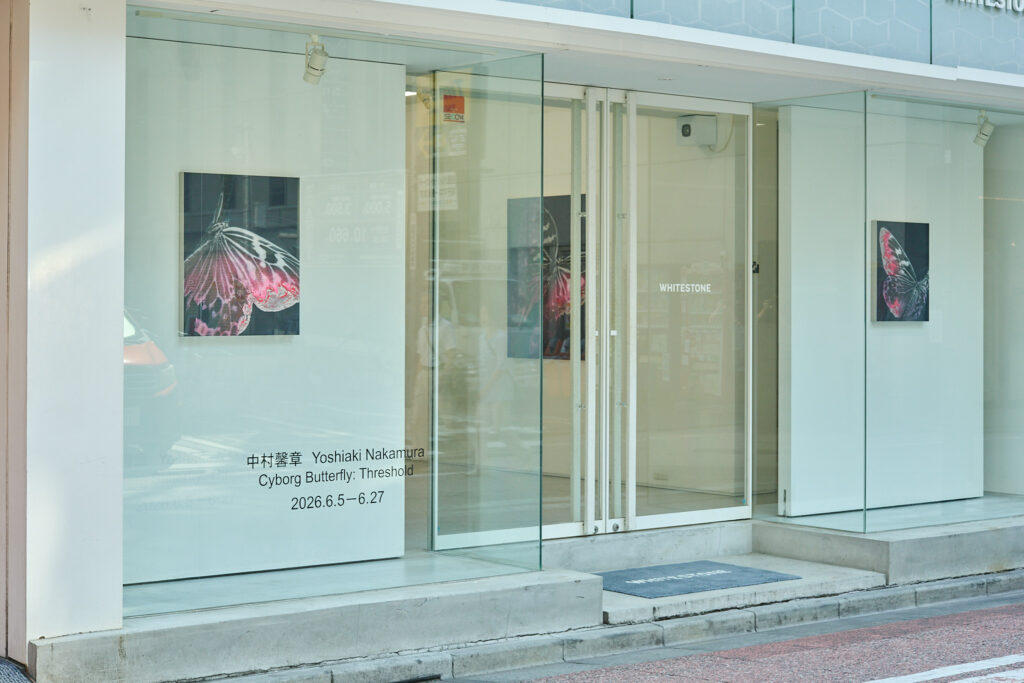
Installation views, 1st floor/ 展示風景(1階)

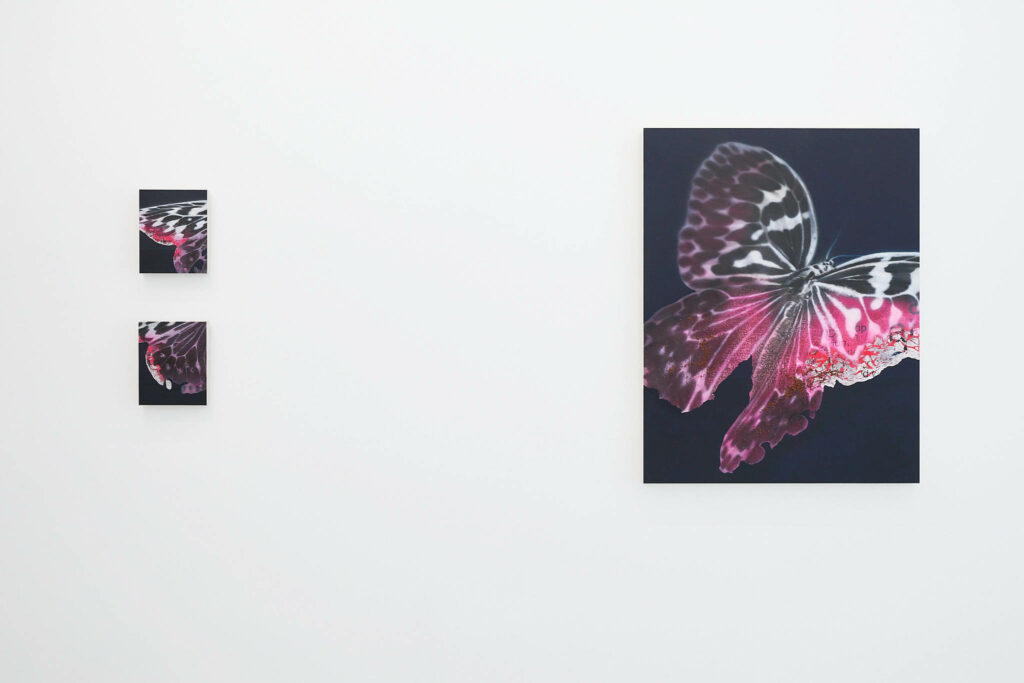
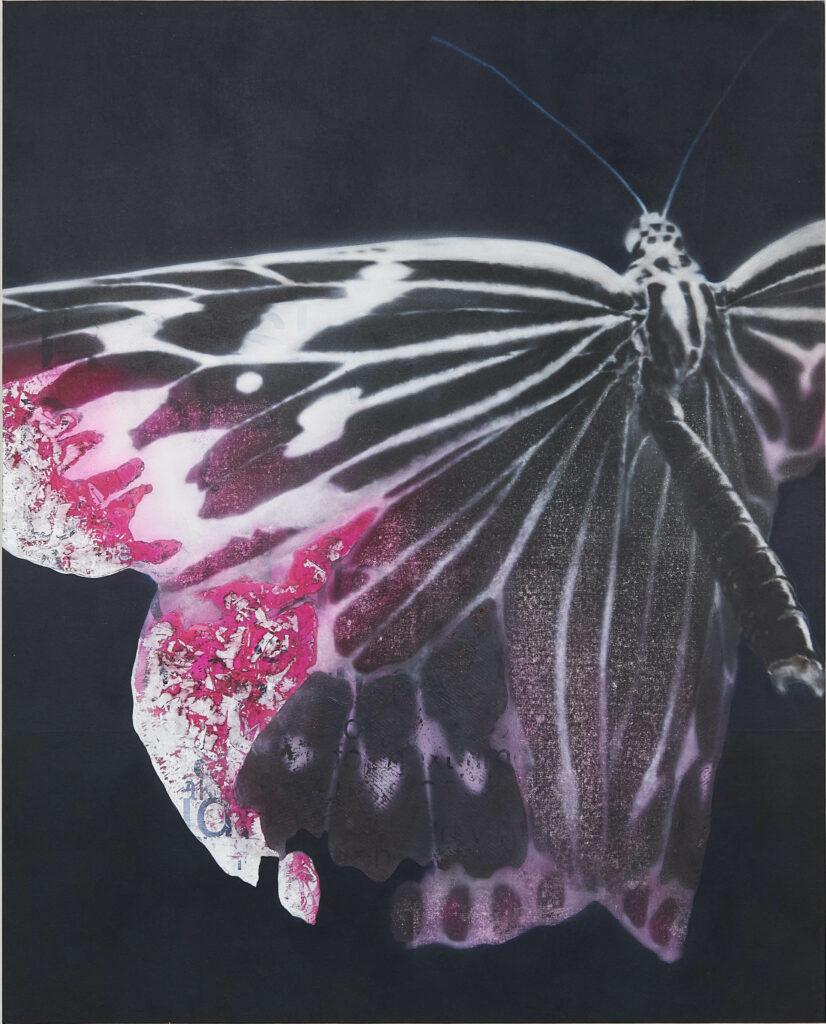
Cyborg Butterfly 1, 2026 (Left)
162.0 x 130.3 cm (63.8 × 51.3 in)
Acrylic, Japanese paper, silver leaf, genuine vermilion, lac dye, copper wire, carbon fiber, holographic powder, UV-reactive paint, bone conduction speaker on wood panel
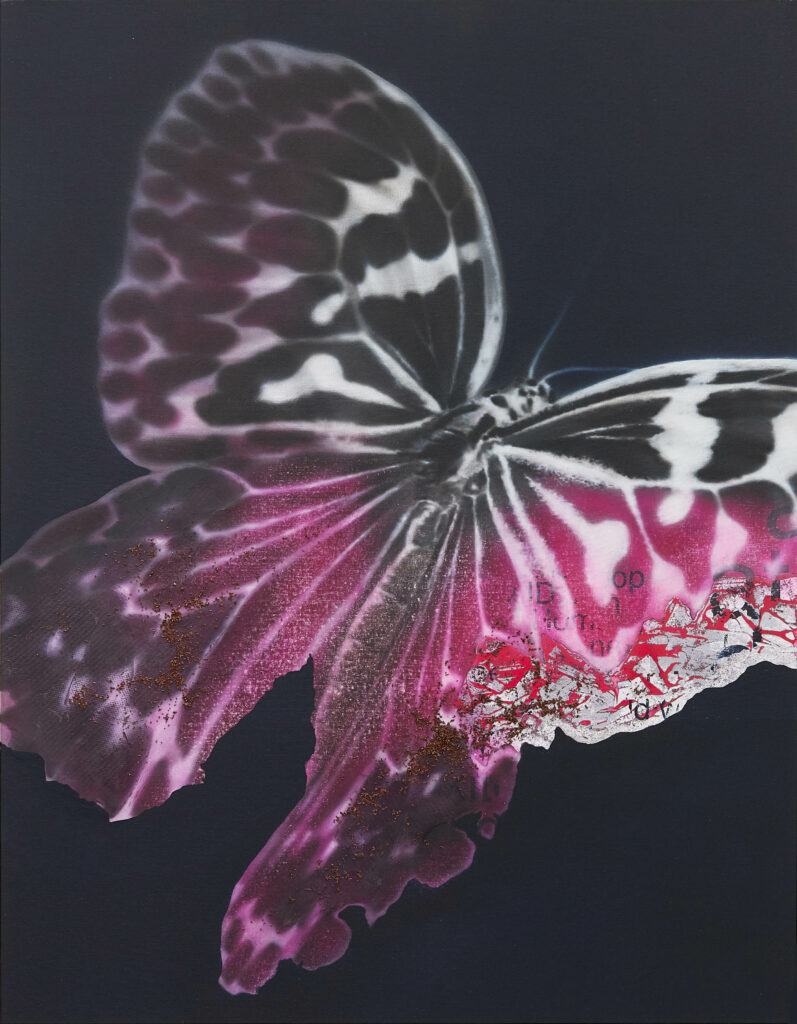
Cyborg Butterfly 5, 2026 (Right)
116.7 × 91.0 cm (45.9 × 35.8 in)
Acrylic, Japanese paper, silver leaf, conductive ink, lac dye, copper wire, carbon fiber, holographic powder, UV-reactive paint, bone conduction speaker on wood panel
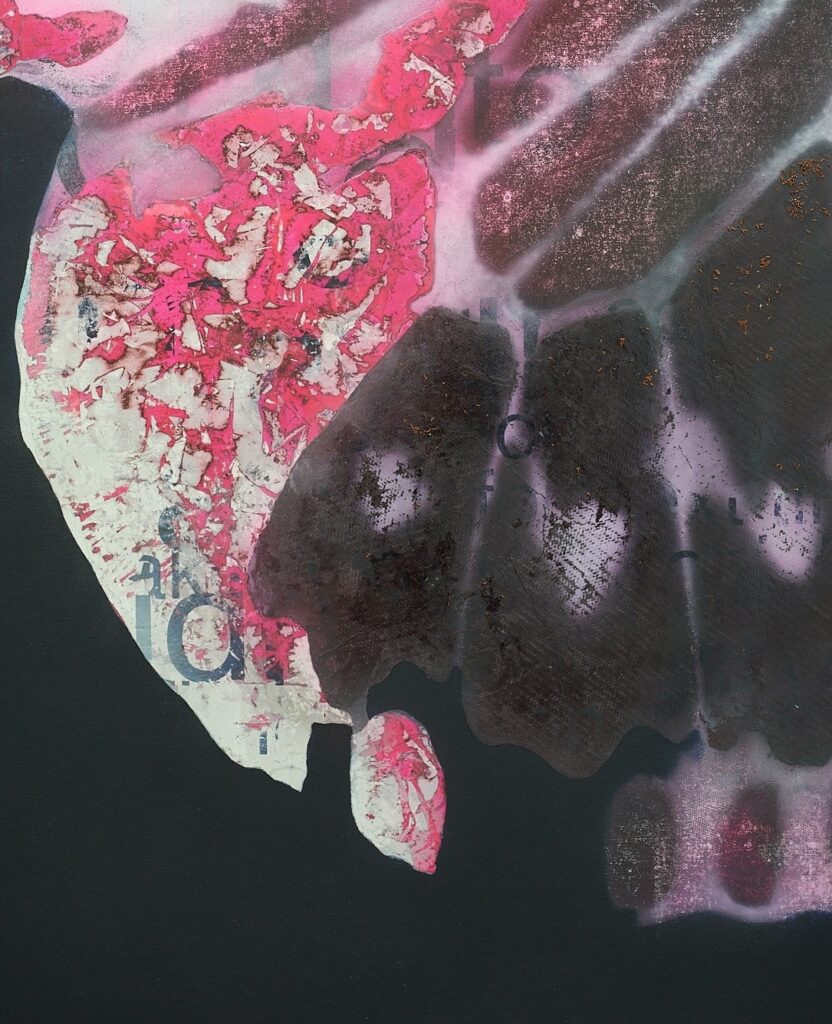

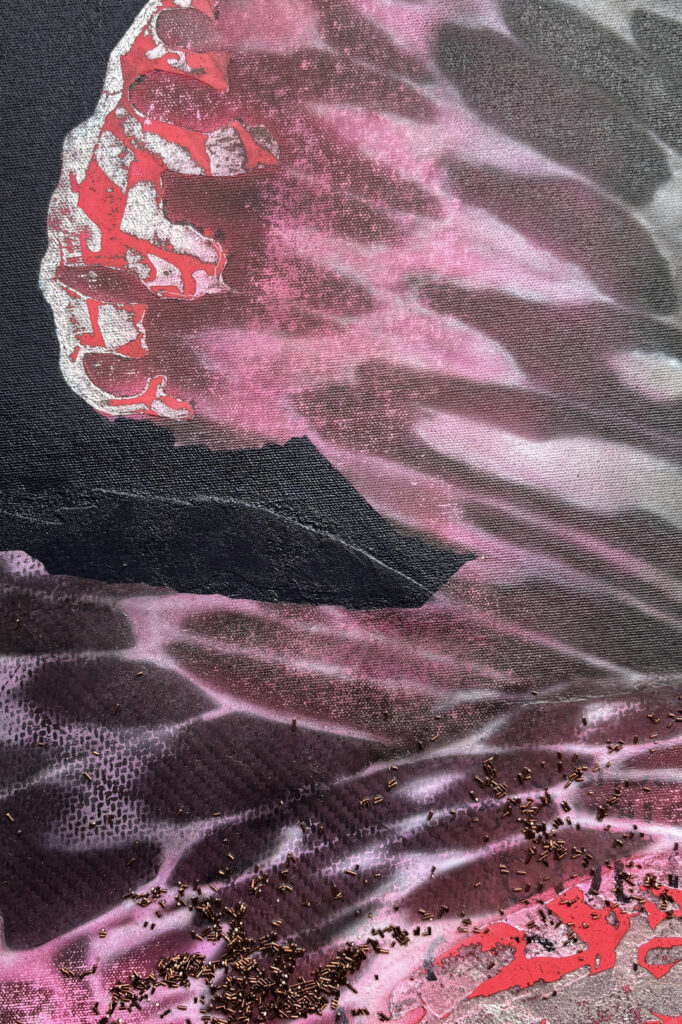
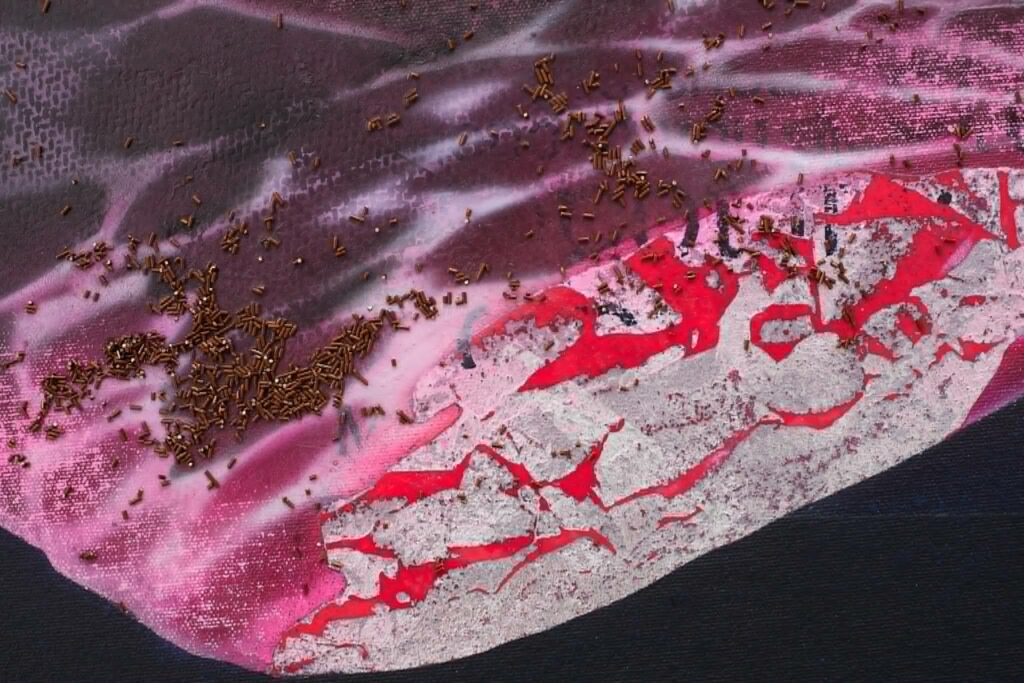
Close-up
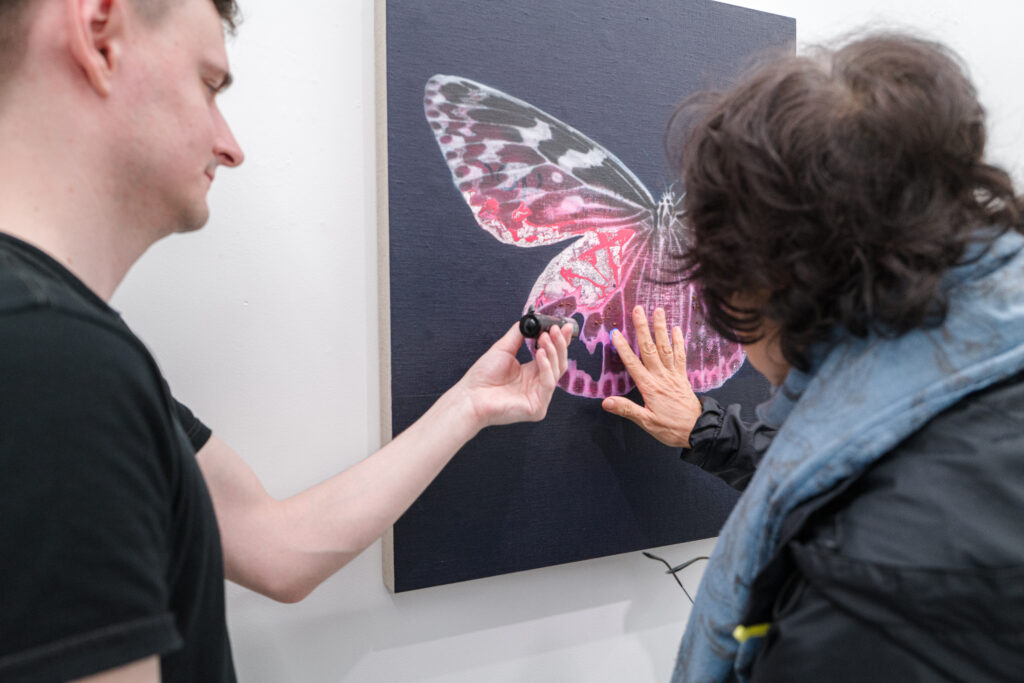
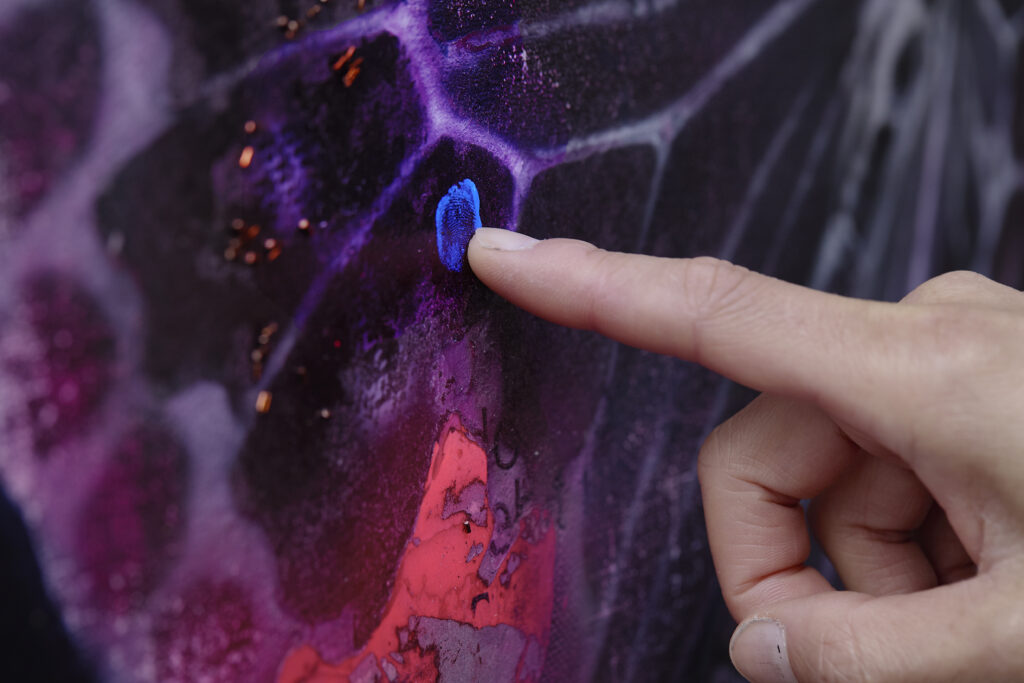
Bone conduction via UV touch interaction
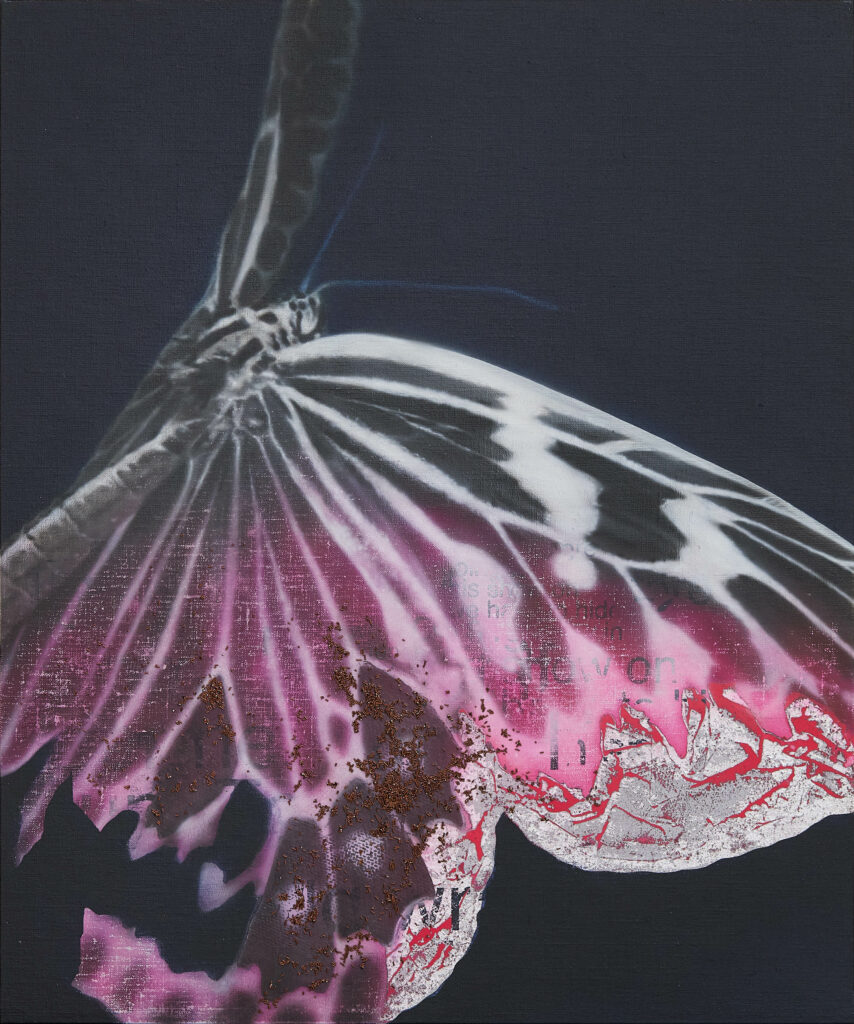
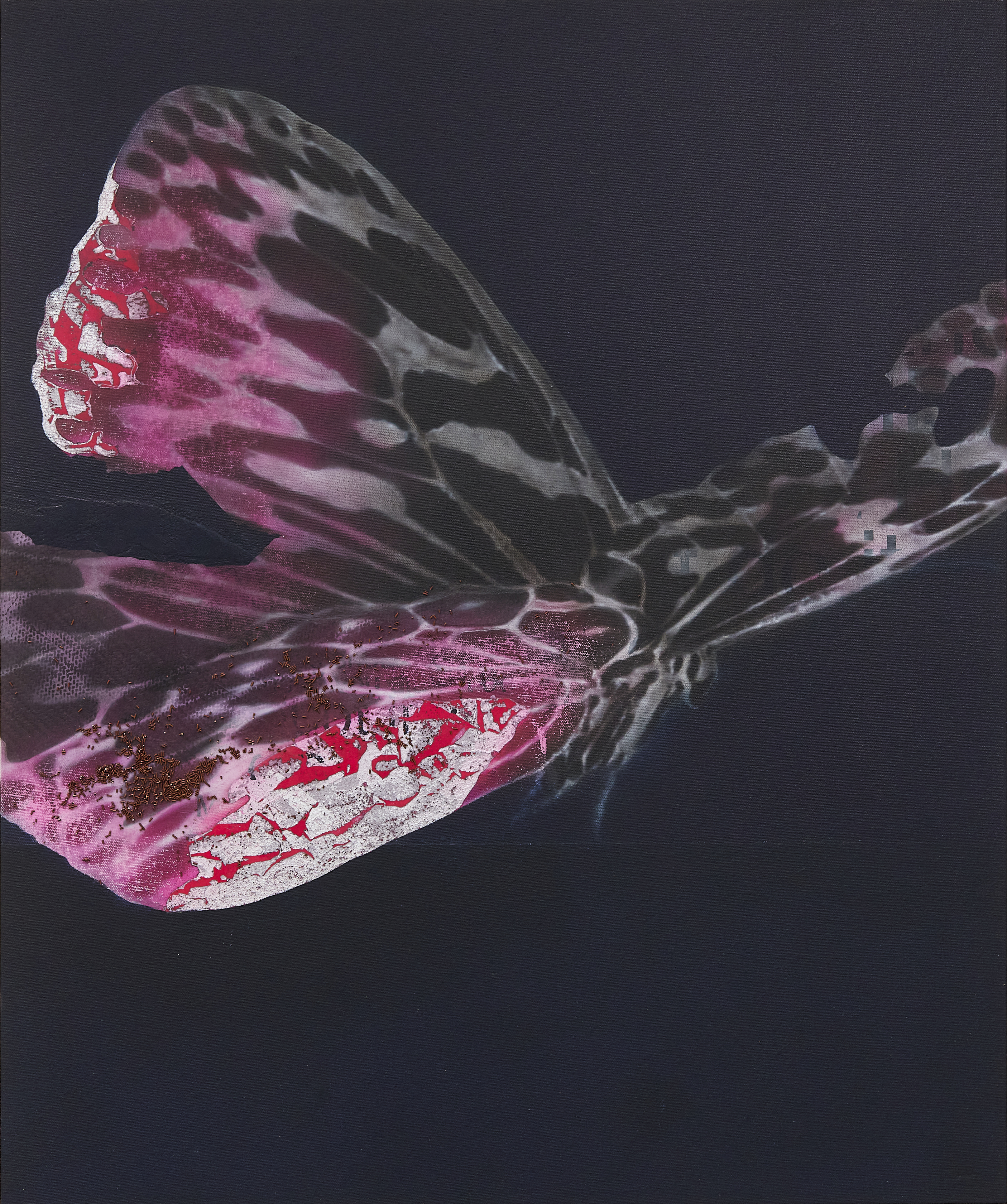
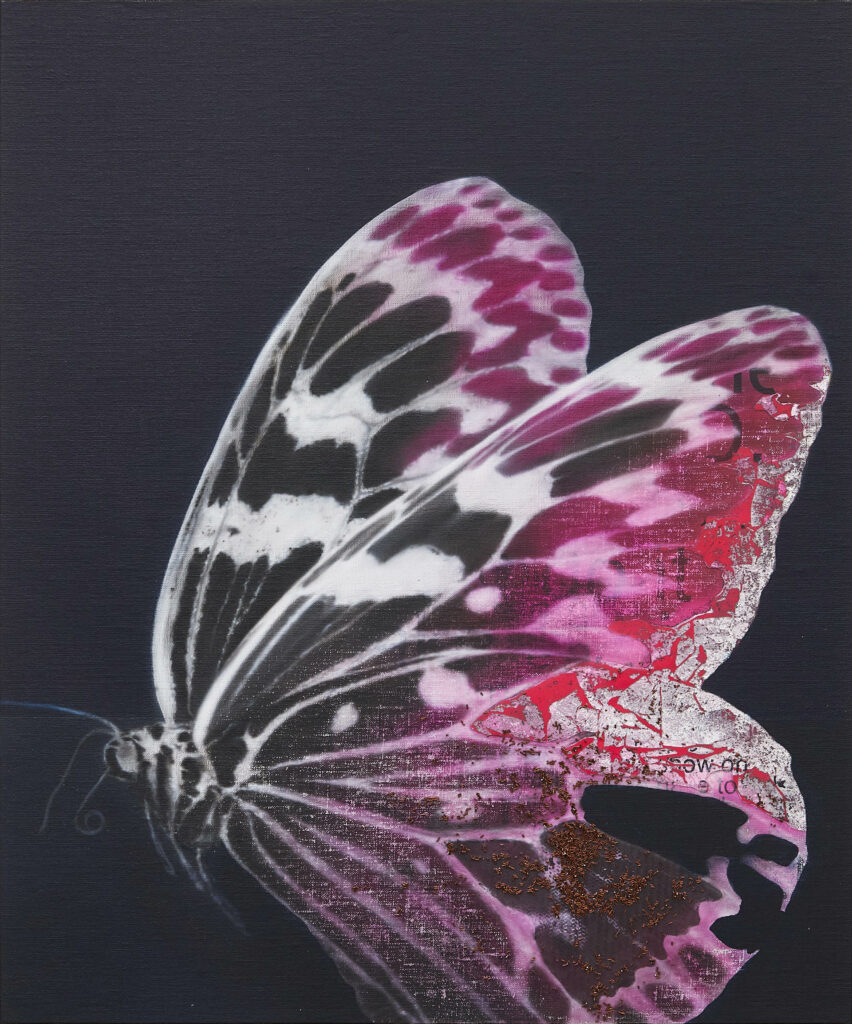
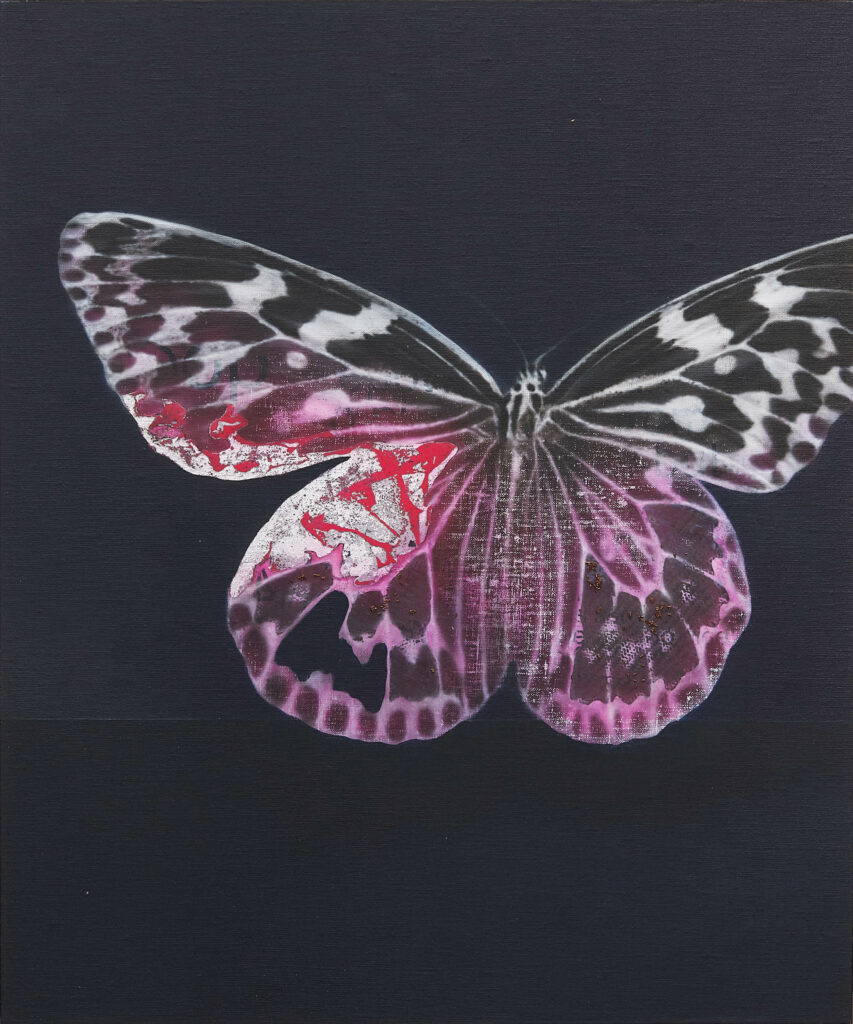
Cyborg Butterfly 7, 2026 (Top, Left)
72.7 × 60.6 cm (28.6 × 23.9 in)
Acrylic, Japanese paper, silver leaf, conductive ink, lac dye, copper wire, carbon fiber, holographic powder, UV-reactive paint, bone conduction speaker on wood panel
Cyborg Butterfly 9, 2026 (Top, Right)
72.7 × 60.6 cm (28.6 × 23.9 in)
Acrylic, Japanese paper, silver leaf, conductive ink, lac dye, copper wire, carbon fiber, holographic powder, UV-reactive paint, bone conduction speaker on wood panel
Cyborg Butterfly 8, 2026 (Bottom, Left)
72.7 × 60.6 cm (28.6 × 23.9 in)
Acrylic, Japanese paper, silver leaf, conductive ink, lac dye, copper wire, carbon fiber, holographic powder, UV-reactive paint, bone conduction speaker on wood panel
Cyborg Butterfly 6, 2026 (Bottom, Right)
72.7 × 60.6 cm (28.6 × 23.9 in)
Acrylic, Japanese paper, silver leaf, conductive ink, lac dye, copper wire, carbon fiber, holographic powder, UV-reactive paint, bone conduction speaker on wood panel
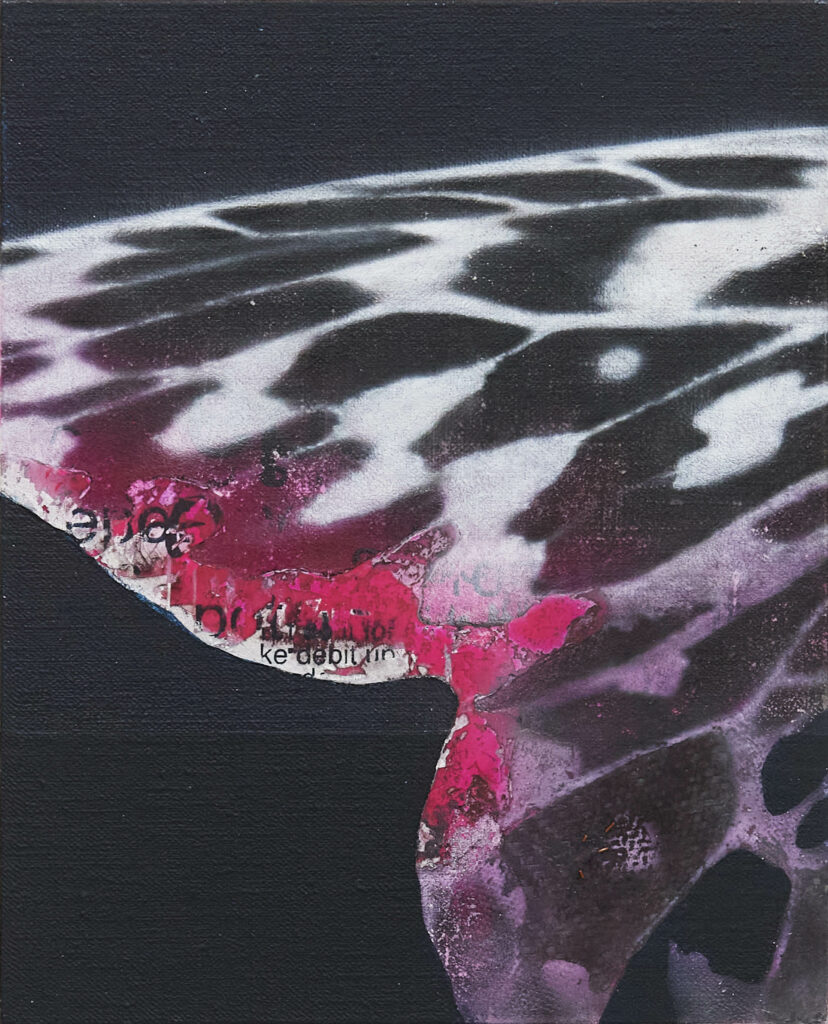
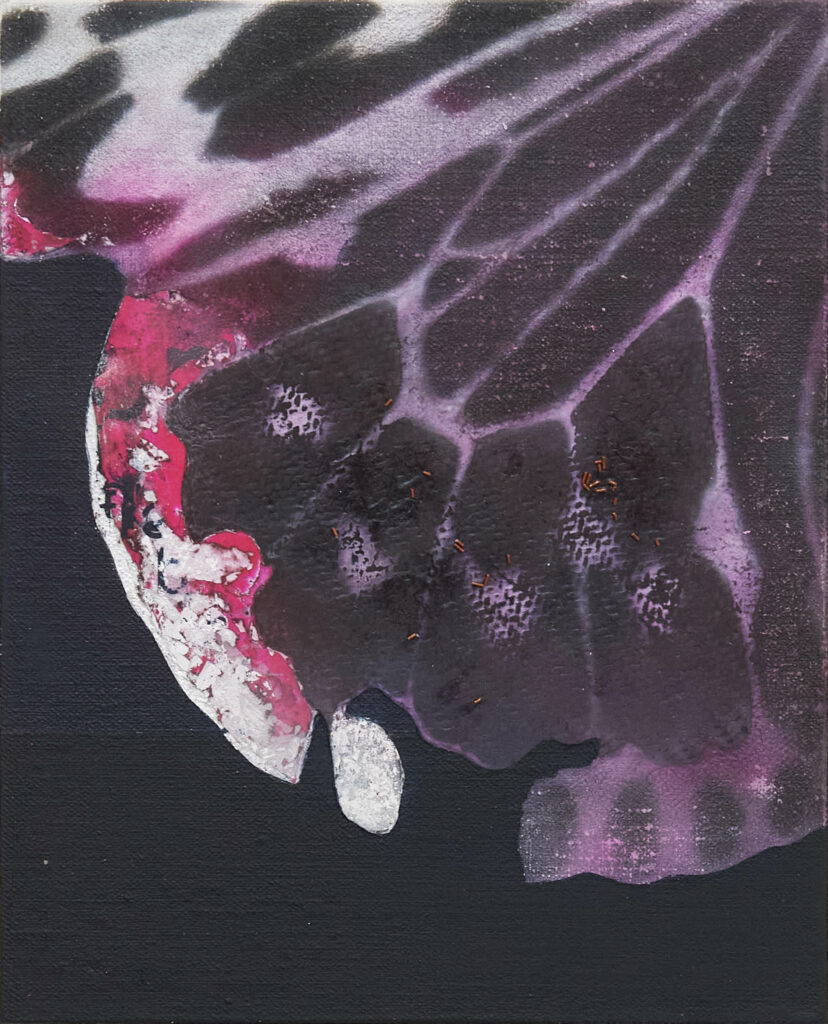
Cyborg Butterfly 2, 2026 (Left)
27.2 × 22.0 cm (10.7 × 8.7 in)
Acrylic, Japanese paper, silver leaf, genuine vermilion, lac dye, copper wire, carbon fiber, holographic powder, UV-reactive paint, bone conduction speaker on wood panel
Cyborg Butterfly 3, 2026 (Middle)
27.2 × 22.0 cm (10.7 × 8.7 in)
Acrylic, Japanese paper, silver leaf, genuine vermilion, lac dye, copper wire, carbon fiber, holographic powder, UV-reactive paint, bone conduction speaker on wood panel
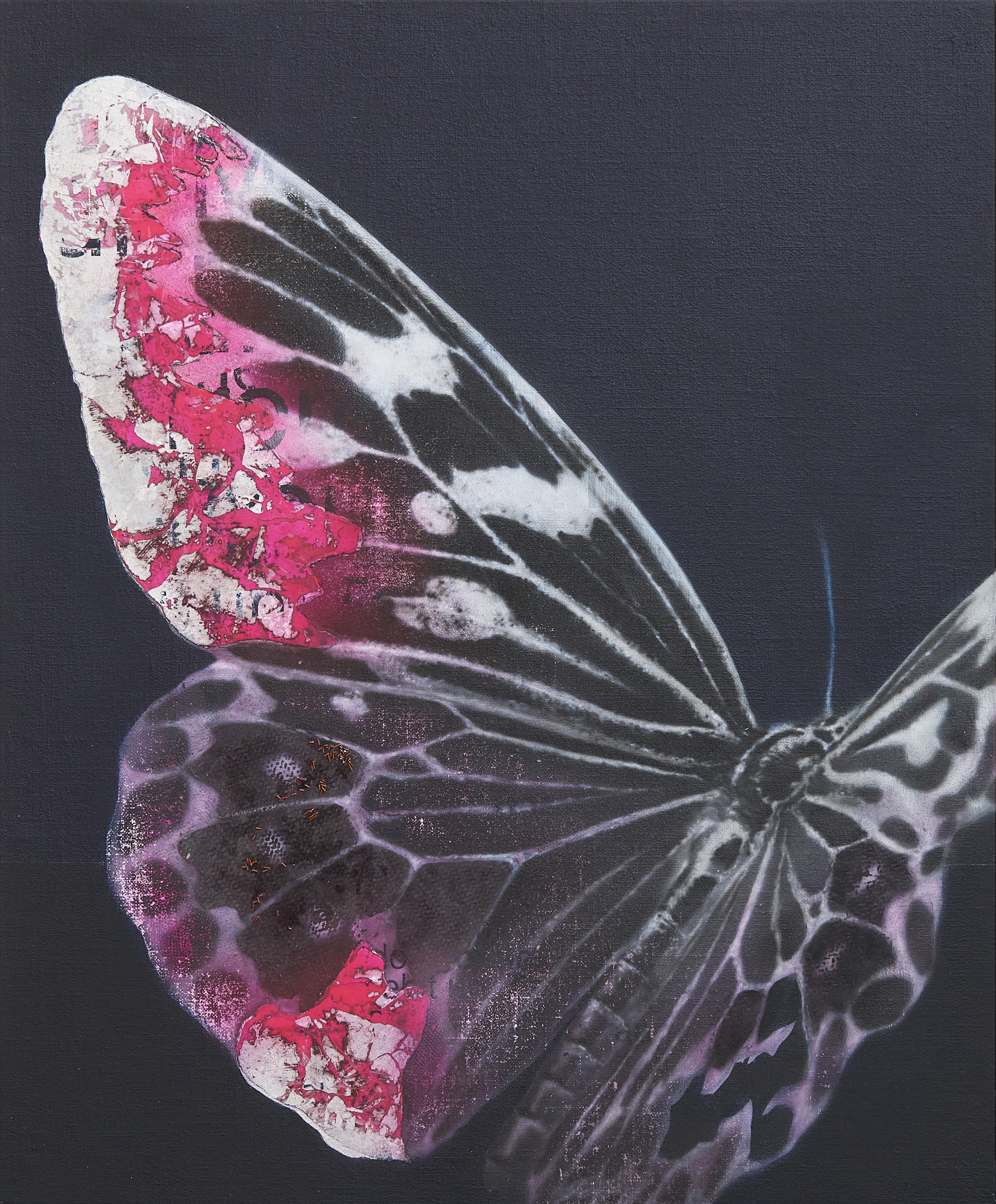
Cyborg Butterfly 4, 2026 (Right)
60.6 × 50.0 cm (23.9 × 19.7 in)
Acrylic, Japanese paper, silver leaf, genuine vermilion, lac dye, copper wire, carbon fiber, holographic powder, UV-reactive paint, bone conduction speaker on wood panel
Between sound and silence. An inquiry into the threshold of perception
Overall Concept
Through my cochlear implant, I live between a world of sound and a world of silence. My work explores the threshold between these two modes of perception across different media—painting, sculpture, and installation. This is not a story of recovery, of regaining lost sound. Rather, it is an attempt to bring into the viewer’s own body the experience of two distinct perceptual worlds existing side by side, in the same place.
Cyborg Butterfly 1-9
The Cyborg Butterfly series is a body of paintings that questions what it means for the human and the technological to merge, rooted in my own transformed experience of hearing. In the silent world, butterflies appeared not as visual images but as “sound.” They were the visual afterimage of perceptual noise, an embodiment of my own perception given form: the Cyborg Butterfly. This butterfly is a symbol of transformation; when viewers touch a designated area of the painting, it becomes sound. The series visualizes the new sensory capacities acquired through cochlear implantation and constitutes an assertion of posthuman identity that departs from traditional anthropocentric conceptions of the body.
The butterfly is more than a metaphor for the cyborg. In her “Cyborg Manifesto,” Donna Haraway proposed that beings who differ from the conventional biological norm—people with disabilities, minorities, cyborgs—dissolve the boundaries between self and others. From an animistic perspective, butterflies have traditionally been believed to be spirits or souls traversing the space between life and death. In this exhibition, they cross the boundary between silence and sound—the boundary line of communication itself. I have employed the cyborg as an expressive motif in various evolving forms since 2017, before moving to the United States, and the butterfly as a spirit or incarnation of sound since 2009, during my Japanese painting period.
Materials such as iPhone text-chat characters inscribed on the butterfly wings, silver leaf, holographic powder, copper wire, and carbon fiber sheets manifest the mechanical body of the cyborg and the materialization of sonic noise. The digital text characters, faintly visible, are drawn from the iPhone-based written conversations I continue to use today. The pink tones, made to appear scorched through the layering of multiple coats of paint, visualize the firing of neural synapses—the neurological response in the perception of sound—and represent a color where beauty and pain coexist. The silent world of the deaf is not absolute silence; it is a world of noise that constantly shifts, with occasional bursts of loud static. Silence and technologically mediated sound continue to coexist within my body simultaneously. This contradiction—where clear perception does not erase noise, nor does noise cancel out clarity—lies at the core of the series. These are, in Donna Haraway’s terms, beings without an origin myth.
The deep navy background has been used since 2009, during my Japanese painting period, as an expression of the silent world. The compositions in which butterflies fill the entire picture plane reflect the immersive quality of visual space as I experience it in the silent world—a perception akin to an enlarged two-dimensional screen. The airbrush, which I have used since around 2013 while enrolled in the doctoral program at Tokyo University of the Arts, represents both the stillness of the silent world and the sharp digital clarity of cochlear implant perception.
In my training in Nihonga, I pursued the technique of layering ink, dyes, gofun (shell white), and mineral pigments to achieve deep translucency while systematically eliminating all traces of the brush. This blurring in Nihonga was not merely a technical choice, but an act of erasing the physical trace of the brush to produce a sense of floating weightlessness and immaterial stillness on the picture surface. It was a necessary methodology for expressing, on a flat plane, my perception of the silent world at that time—a sensory realm where contours and backgrounds dissolve into one another and no boundary of sound exists.
The transition to airbrush from 2013 onward—when I regained hearing through cochlear implantation (strictly speaking, a different kind of sound mediated by electronic signals)—is an extension of this perceptual necessity. The uniform deposition of atomized particles eliminates the trace of the brush as a bodily tool even more thoroughly, while simultaneously realizing on the picture surface the sharp digital clarity of cochlear implant perception—simple and elusive, yet piercing in quality, distinct from the soft, analog quality of a brushstroke. For me, Nihonga blurring and airbrushing are inseparable techniques for making two perceptual worlds that exist within me—silence and elusive sound—coexist within a single painting. I once lived in a silent world where visual space was dominant, examining each object one by one, confirming it as if by touch. This work clearly reflects that mode of perception.
The restriction of color is likewise grounded in perceptual necessity. The limited palette of the butterfly forms—black, silver, magenta, and pink—visually reflects the quality of digitally mediated sound produced by the cochlear implant: vivid, yet bandwidth-limited perception. The crisp rendering achieved through airbrush serves as a visual point of entry, while the restricted color palette functions as a metaphor for the robotic, black-and-white quality of implant-generated sound, intentionally suppressing retinal pleasure and directing the viewer’s attention toward the question: what is perception? This methodology, which has consistently limited color since my Japanese painting period, is rooted in both the restrained chromatic sensibility of the silent world and the vivid yet limited sonic perception of the cochlear implant.
Bone conduction speakers are embedded behind the panel of every work and linked via Bluetooth to an iPhone. To question the nature of the body, sensation, and their relationship, the works incorporate a haptic mechanism that allows viewers to feel sound and vibration by touching the surface of the painting. When a blacklight is applied, the areas to be touched are revealed; upon contact, noise sounds from the bone conduction speaker behind the panel, while vibration travels through the body. The work is not only to be “seen” but to be “touched and felt.” This approach embodies the recognition that sound can be perceived through touch and is not limited to hearing. The viewer experiences dialogue with the work through their own body. When touching the painting, vision is converted through touch into hearing—the viewer’s body becomes the interface of perception.
In the context of relational art, which foregrounds the relationship and communication between the work and the viewer, this series questions communicative relationships from the perspective of a body shaped by differences in hearing. Yet mutual understanding is not the sole aim; it is also a space for sharing discomfort that resists language, questions that remain open, and the irreducibility of not fully knowing one another. My aim is not to eliminate difference, but to create conditions in which difference itself can be mutually felt.
John Cage declared that “silence does not exist,” reframing music from a new perspective. I seek to extend Cage’s insight from the viewpoint of a new body, visualizing sounds that have never been perceived and sounds that exist only internally. By reinterpreting the Nihonga concepts of yohaku (negative space) and ma (interval) in a contemporary context, I express the aesthetics of silence. Indeed, even in a world without sound, faint yet rich Threshold undeniably exist; true silence does not exist.
Neuroscientist Anil Seth has proposed that all perception is a “controlled hallucination” generated from within the brain. What we call reality is merely the result of the brain’s predictions being regulated by sensory input. My own experience resonates deeply with this theory. Sounds that should exist in the same way in the external world are heard differently when the mapping of my cochlear implant is changed; even when the implant is switched off, the brain continues generating phantom noise. Sound, then, is not an objective reflection of the external world, but a perceptual construction of the brain. If this is so, the assumption that everyone hears and sees alike is itself an illusion, and the boundary between “normal perception” and “abnormal perception” may be nothing more than something we have constructed.
音と沈黙の間で -知覚の閾値をめぐる探究-
全体のコンセプト
私は人工内耳を通して、音のある世界と、無音世界の間に生きている。そして、その知覚の間(閾値)を、絵画・彫刻・インスタレーションという異なる媒体で探究してきた。これは、失われた音を取り戻す回復の物語ではない。むしろ二つの異なる知覚の世界が、同じ場所に並んで存在すること、その経験を鑑賞者の身体に届けようとする試みである。
Cyborg Butterfly(サイボーグバタフライ)シリーズ
Cyborg Butterfly シリーズは、「⼈間とテクノロジーの融合とは何か」を問いかける絵画群であり、私⾃⾝の変容した聴覚体験を起点としている。無⾳世界において、蝶は視覚的イメージとしてではなく「⾳」として現れていた。それは知覚的ノイズの視覚的な残響であり、⾃⼰の知覚そのものを形象化した存在、すなわちサイボーグバタフライである。この蝶は変容の象徴であり、指定された絵の⼀部に触れると⾳になる存在である。本シリーズは、私が⼈⼯内⽿の装⽤によって獲得した新たな感覚を視覚化したものであり、伝統的な⼈間中⼼主義的⾝体観から逸脱したポストヒューマンとしてのアイデンティティの表明である。
蝶という存在は、サイボーグのメタファーにとどまらない。ダナ・ハラウェイは「サイボーグ宣⾔」において、障がい者やマイノリティ、サイボーグのように通常の⽣物とは異なる存在が他者との境界線を無化すると提唱した。アニミズムでは、蝶は伝統的に⽣死の間を⾶び交う霊の存在や霊魂とされてきている。本展示において、蝶は沈黙と⾳の間、いわばコミュニケーションの境界線を横断する。私はさまざまな姿形を変えながらサイボーグとしての表現を、渡⽶前の2017年から、また精霊や⾳の化⾝としての蝶を⽇本画時代の2009年から⽤いてきた。
蝶の⽻に描かれたiPhoneの筆談⽂字、銀箔、ホログラムパウダー、銅線、カーボンシートといった素材は、サイボーグの機械的⾝体と⾳のノイズの物質化を表している。わずかに見えるよう記されているデジタルの筆談⽂字は、現在も私がiPhoneによる筆談で用いているものである。絵の具を多層重ねたことにより焦げているように⾒せたピンクは、脳のシナプスの発⽕、すなわち⾳の知覚における神経的反応の視覚化であり、美しさと痛みの共存を表している。聴覚障がい者の無音世界は全くの無音ではなく、常に変化し、時折大きな雑音が聞こえるノイズの世界でもある。沈黙とテクノロジーによる⾳は、私の⾝体の中に同時に存在し続ける。すなわち、この鮮明な知覚がノイズを消すわけでもなく、ノイズが鮮明さを打ち消すわけでもないという⽭盾性こそが、本シリーズの核にある。いわば、ダナ・ハラウェイがいうところの、神話の起源を持たない存在である。
紺⾊の背景⾊は、2009年の⽇本画時代から⽤いてきた無⾳世界の表現である。蝶が画⾯⼀杯に映り込む構図は、私が無⾳世界で感じる視空間の没⼊感、拡⼤された2Dのスクリーンのような知覚表現である。2013 年頃、東京芸術⼤学の博⼠課程在籍時から使⽤してきたエアブラシは、無⾳世界の静寂さと⼈⼯内⽿による鮮明なデジタル知覚の双⽅を表象する。
私は⽇本画の修練において、墨、染料、胡粉、岩絵具などを何層にも深く透明感が出るまで重ね、筆跡を徹底的に消すぼかしの技法を追求してきた。⽇本画におけるこのぼかしは単なる技術的選択ではなく、筆の物理的痕跡を消し去ることで画⾯に浮遊感と⾮物質的な静けさを⽣み出す⾏為であった。これは、当時の私の無⾳世界の知覚、すなわち輪郭と背景が曖昧に溶け合い、⾳の境界が存在しない感覚世界を平⾯上に表現するための必然的な⽅法論であったといえる。
私が人工内耳装用により聴覚を再獲得(厳密には電子信号を介した異なる音)した2013 年よりエアブラシへ移⾏したのは、この知覚を表現するための必然性の延⻑にある。噴霧による均質な粒⼦の堆積は、筆という⾝体的道具の痕跡をさらに徹底的に排除し、同時に⼈⼯内⽿がもたらすデジタル的な知覚の鮮明さ、シンプルで曖昧ながらも鋭く響き、筆のタッチのようなアナログ的で柔らかい⾳とは異なる質感を画⾯上に実現する。⽇本画のぼかしとエアブラシは、「沈黙」と「捉え難い⾳」という私の中で存在する⼆つの知覚世界を⼀枚の絵画に共存させるための、不可分な技法である。私はかつて視空間が突出した無⾳世界において、対象を⼀つ⼀つ凝視し、触れるように確認していた。この作品は、その知覚様式をクリアに反映させている。
同様に、⾊彩の制限もまた知覚的必然性に基づいている。⿊、銀、マゼンタ、ピンクという限られた蝶本体の⾊彩は、⼈⼯内⽿がもたらすデジタル⾳の質感、すなわち鮮烈でありながら帯域が制限された知覚を視覚的に反映したものである。
エアブラシによる明快な描写は、視覚的な入り口として機能させている。制限された⾊彩パレットは⽩⿊に例えられるロボットのような⾳の暗喩であり、また網膜的な快楽を意図的に抑制し、鑑賞者の意識を「知覚とは何なのか?」という問いそのものへ向かわせる。私が⽇本画時代から⼀貫して用いてきた、この⾊彩を絞る⽅法論は、無⾳世界の抑制された⾊彩感覚と、⼈⼯内⽿による鮮明だが限定的な⾳の知覚の双⽅に根ざしている。
全作品のパネル裏には⾻伝導スピーカーが内蔵されており、iPhoneのBluetooth でリンクする。⾝体と感覚そのもの、そしてその関係性とは何かを鑑賞者に問うために、絵画の表⾯に触れることで⾳や振動を感じられるハプティックの仕組みを取り⼊れている。ブラックライトを当てると触れるべき場所が浮かび上がり、⼿で触れるとパネル裏の⾻伝導スピーカーからノイズ⾳が鳴りながら振動に伝わる。絵画を「⾒る」だけでなく「触れて感じる」作品である。この⼿法は、「⾳は触覚を通じても知覚可能であり、聴覚に限定されない」という認識を具現化したものであり、鑑賞者は作品との対話を⾃らの⾝体を通じて経験する。絵画に触れると、視覚は触覚を経由して聴覚に変換される、すなわち鑑賞者の⾝体が知覚のインターフェースとなる。
作品そのものよりも観客との関係性やコミュニケーションを中⼼に据えるリレーショナルアートの形式の⽂脈において、本作は「コミュニケーションにおける関係性」を聴覚の差異により⾝体の観点から感じることができるように問いかけている。ただし本作品は他者と理解し合うことだけが⽬的なのではなく、⾔葉にならない不快感や問い、わかり得なさを共有する場でもある。すなわち異なる知覚空間を持つ人々の間の差異をなくすのではなく、違いがあることそのものを互いに感じ取れるようにする。
ジョン・ケージは「沈黙は存在しない」とし、⾳楽を新しい枠組みから捉え直した。私はこのケージの視点を新しく「⾝体」の観点から拡張しようとしており、これまでに知覚されてこなかった⾳や内⾯的な⾳を視覚化してきた。例えば⽇本画における「余⽩」や「間」の概念を現代的に再解釈することで、沈黙の美学を表現している。実際、⾳のない世界にも微かで豊かな響きが確かに存在しており、真の静寂は存在しないのだ。
また神経科学者アニル・セスは、すべての知覚は脳が内側から⽣成する「コントロールされた幻覚(controlled hallucination)」であると提唱した。我々が現実と呼んでいるものは、脳の予測が感覚によって制御された結果にすぎない。私⾃⾝の経験は、この理論と深く共鳴する。外界で同じように存在しているはずの音が、⼈⼯内⽿のマッピングを変えれば異なって聞こえ、⼈⼯内⽿をオフにしても脳は幻のノイズ⾳を⽣成し続ける。すなわち⾳は外界の客観的な反映ではなく、脳が構築した知覚そのものである。そうであるならば、「誰もが同じように聞き、同じように⾒ている」という、人々が抱く前提こそが幻想であり、「正常な知覚」と「異常知覚」の境界線もまた、我々が構築してきたものにすぎないのではないか。
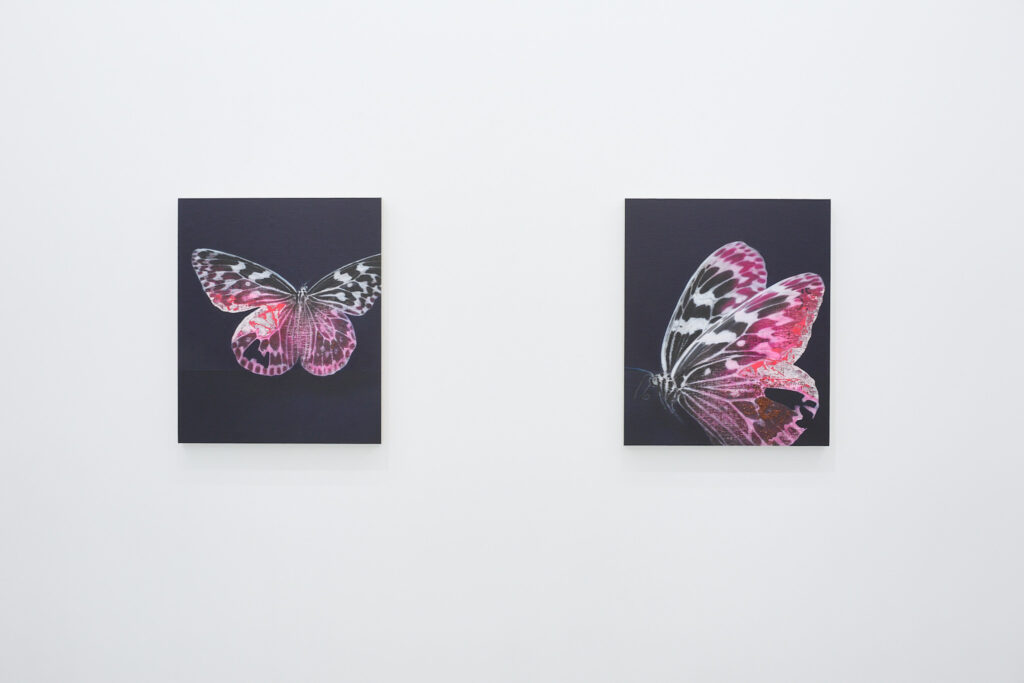
Photo by Masataka Kougo
撮影:向後真孝